IB TOK Essay Tips: How to Build a Strong Argument
Writing a strong TOK essay requires clear claims, counterclaims, real-life examples, and thoughtful evaluation. Here is how to improve your TOK essay.
The Theory of Knowledge essay is one of the most unique parts of the IB Diploma Programme. Unlike regular subject essays, the TOK essay asks students to explore how knowledge is created, tested, accepted, challenged, and interpreted.
A strong TOK essay does not simply give opinions. It builds a balanced argument using claims, counterclaims, real examples, and thoughtful evaluation.
Understand the prescribed title
The first step is to understand the prescribed title carefully. Every TOK essay is based on one of the official titles provided by the IB. These titles are usually broad, philosophical, and open to interpretation.
Before writing, identify the key terms in the title. Words such as certainty, evidence, objectivity, interpretation, values, creativity, responsibility, and truth need careful explanation.
Do not rush into examples before understanding what the title is asking.
Define key terms
A strong TOK essay defines important terms clearly. You do not need dictionary definitions. Instead, explain how you will use the terms in your essay.
For example, if your title includes the word “evidence,” explain whether you mean scientific data, historical documents, personal experience, mathematical proof, or expert testimony.
Clear definitions help your essay stay focused.
Choose suitable Areas of Knowledge
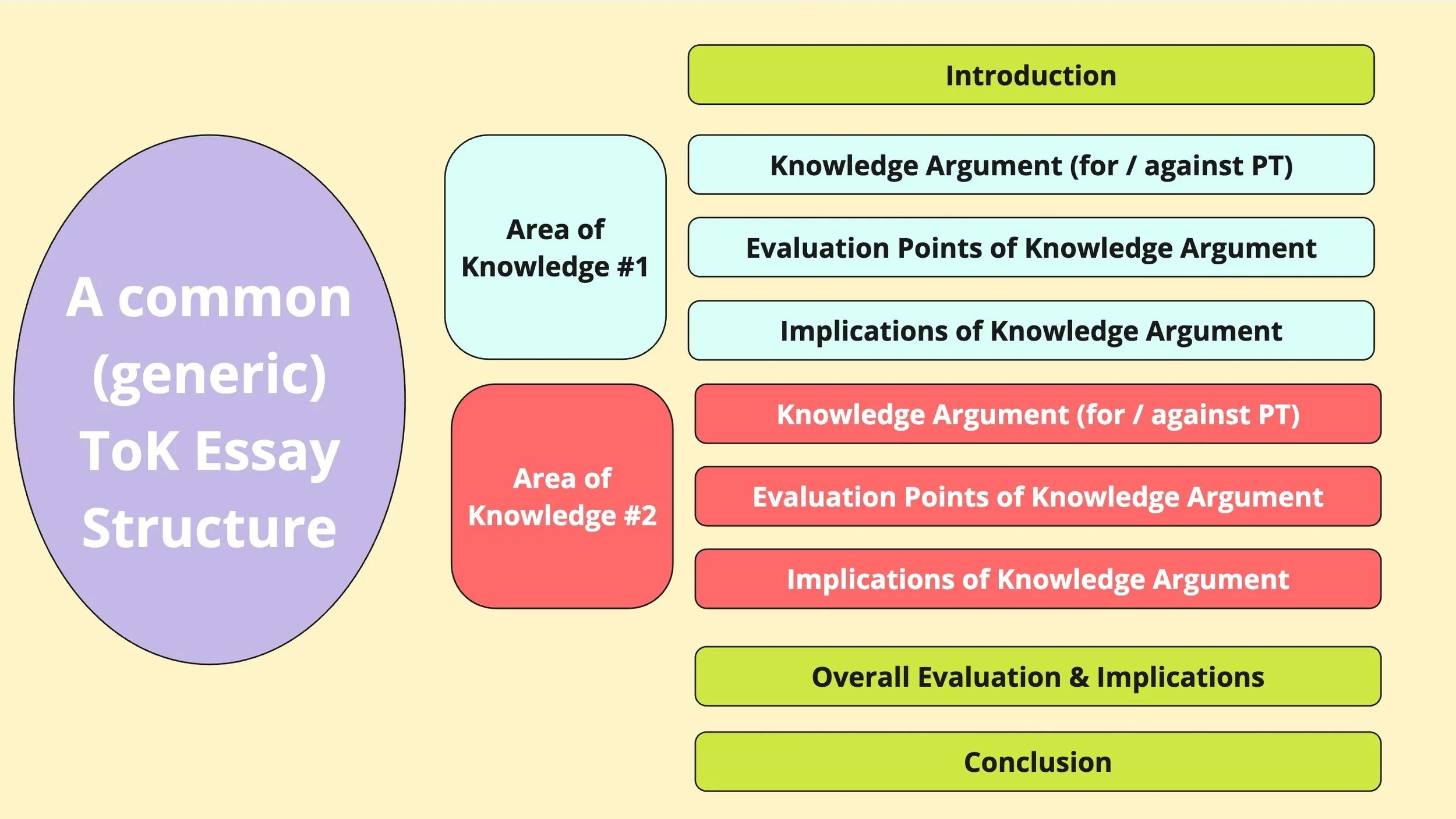
TOK essays usually discuss different Areas of Knowledge, such as natural sciences, human sciences, history, mathematics, the arts, and ethics.
Choose Areas of Knowledge that allow meaningful comparison. For example, you might compare how evidence works in history and natural sciences, or how interpretation works in the arts and human sciences.
Avoid choosing an Area of Knowledge just because it sounds impressive. Choose one that helps answer the title.
Build claims and counterclaims
A TOK essay should show balanced thinking. A claim presents one side of the argument. A counterclaim challenges or limits that argument.
For example, you might claim that scientific knowledge is reliable because it is based on evidence and testing. A counterclaim could be that scientific knowledge can change when new evidence appears.
This balance shows that you understand complexity.
Use specific examples
Examples are essential in TOK, but they must be specific. Avoid vague examples such as “scientists use evidence” or “artists express emotions.”
Use real examples from history, science, mathematics, art, or current knowledge debates. Explain how each example supports your argument.
The example should not take over the essay. It should serve your analysis.
Evaluate, do not describe
One common mistake is describing examples without explaining their significance. TOK requires evaluation.
Ask yourself:
What does this example show about knowledge? Does it support or challenge the title? What are the limitations? How does it compare with another Area of Knowledge?
Evaluation is what makes your essay analytical.
Link every paragraph to the title
Each paragraph should connect directly to the prescribed title. If a paragraph does not help answer the question, remove it or rewrite it.
Use clear linking sentences to show how your argument develops.
Write a strong conclusion
Your conclusion should not simply repeat the introduction. It should show what you have discovered through your discussion.
A good TOK conclusion recognises complexity and avoids extreme statements.
Final advice
A strong TOK essay is clear, balanced, analytical, and focused. Define your terms, choose relevant Areas of Knowledge, use specific examples, evaluate carefully, and keep linking back to the title. With planning and revision, TOK can become a powerful part of your IB score.
Need a tutor for this subject?
Share your city, programme stage and subject — the IB Gram advisor team replies with a small, honest shortlist.